How to Lose Weight Without Feeling Hungry
The biggest enemy of weight loss isn't lack of willpower it's hunger. Learn the science of satiety and how to structure your meals to stay full while in a deficit.
Azeem Iqbal
Nutrition Expert
Table of Contents
- How to Lose Weight Without Feeling Hungry
- The Science of Satiety: Why We Get Hungry
- Strategy 1: The “Volume Eating” Hack
- Strategy 2: Prioritize Protein at Every Meal
- Strategy 3: Don’t Fear Healthy Fats
- Strategy 4: The Fiber Factor
- Strategy 5: Hydration as a Tool, Not a Chore
- Summary: Full Stomach, Leaner Body
How to Lose Weight Without Feeling Hungry
If you ask someone why they quit their diet, the answer is almost always the same: “I was starving.”
We have been conditioned to believe that hunger is the price of weight loss. That if your stomach isn’t growling, you aren’t burning fat. This is not only false; it is the primary reason diets fail.
You cannot fight your biology. Evolution has wired your brain to treat hunger as an emergency. If you try to “willpower” your way through starvation, your brain will eventually hijack your behavior and force you to binge.
The secret to sustainable result is to learn how to lose weight without feeling hungry. This involves manipulating the “satiety index” of foods to keep your belly full even while your calories remain low.
Fuel with purpose: To master hunger, you need to master your macros. Use our Protein and Fat Guides to understand exactly how these nutrients interact with your hunger hormones.
The Science of Satiety: Why We Get Hungry
Hunger isn’t just an empty stomach; it’s a chemical signal.
- Ghrelin: The “I’m Hungry” hormone. It spikes when your stomach is empty.
- Leptin: The “I’m Full” hormone. It tells your brain you have enough energy.
- Stretch Receptors: Nerves in your stomach wall that fire when the organ is physically expanded.
To lose weight without misery, we need to suppress Ghrelin and trigger the Stretch Receptors.
Strategy 1: The “Volume Eating” Hack
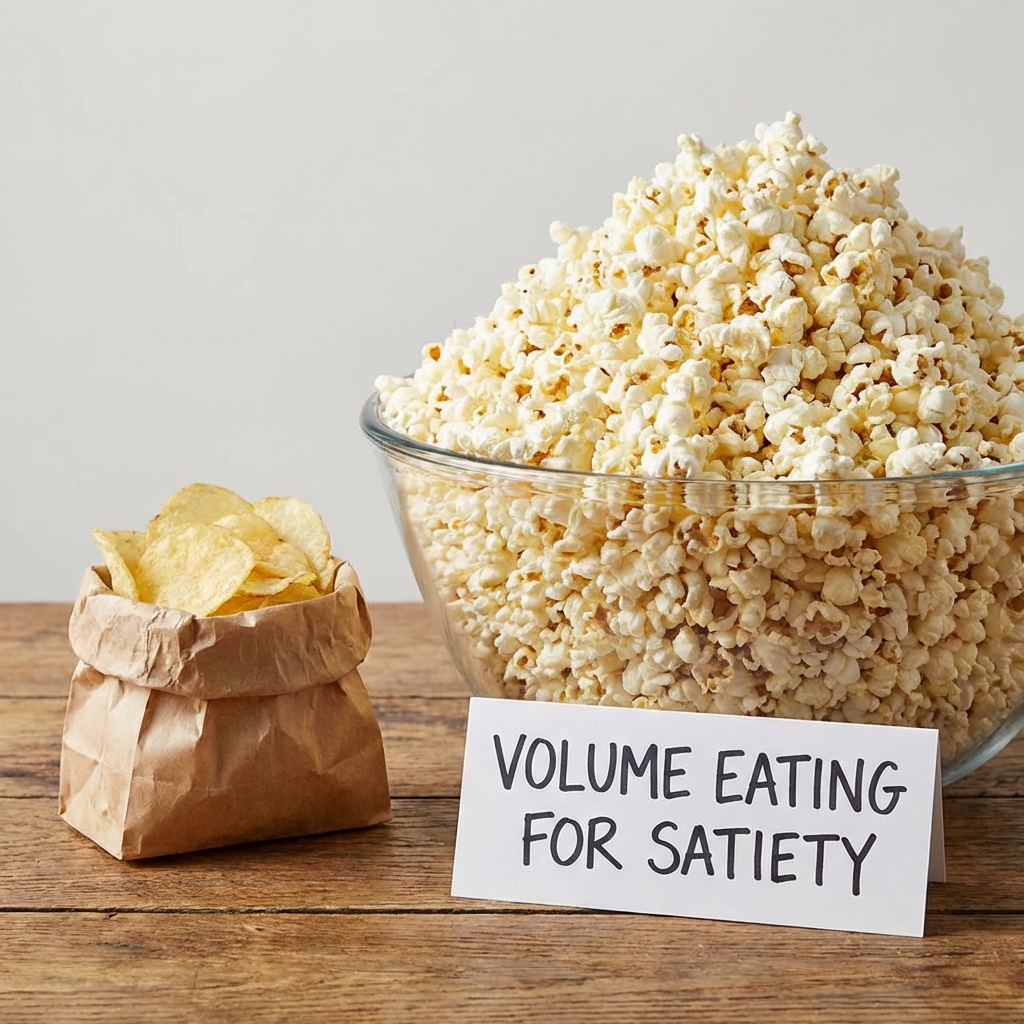
This is the single most effective tool for appetite control weight loss.
Imagine 500 calories of oil. It takes up almost no space in your stomach. Now imagine 500 calories of broccoli. You physically couldn’t eat it all. It would fill your entire digestive tract.
Volume Eating means choosing foods that are big in size but small in calories.
- Swap: 1 cup of Rice (200 cal) -> 1 cup of Cauliflower Rice (25 cal).
- Swap: Potato Chips (150 cal/oz) -> Air-Popped Popcorn (30 cal/cup).
- Swap: Dried Fruit (dense) -> Fresh Melon (volume).
By filling your plate with these foods that reduce hunger, you trigger those stretch receptors without blowing your calorie budget.
Strategy 2: Prioritize Protein at Every Meal
Protein is the king of satiety. Studies consistently show that protein reduces hunger levels significantly more than carbohydrates or fats.
When you eat protein, it requires more energy to digest (Thermic Effect of Food) and it releases a potent satiety hormone called PYY.
The Rule: never eat a “naked carb.” If you have an apple, pair it with yogurt. If you have toast, add an egg. High protein diet for weight loss isn’t just about muscle; it’s about checking the hunger box.
Strategy 3: Don’t Fear Healthy Fats
While we want to limit fat because it is high in calories, we need some fat to slow down digestion. Fat is the “brake pedal” of the gut.
A salad with zero-fat dressing will leave the stomach in 60 minutes. A salad with 1 tablespoon of olive oil will stay there for 3 hours.
The Balance: Use fats as a garnish, not the main event. A quarter avocado or a sprinkle of nuts is enough to get the anti-hunger benefits.
Strategy 4: The Fiber Factor
Fiber is the “bulk” that your body cannot digest. It absorbs water and expands in your stomach like a sponge.
Soluble Fiber (found in oats, beans, flax) turns into a gel that physically slows down the movement of food through your intestines. This keeps your blood sugar stable and prevents the “crash” that leads to the 3:00 PM vending machine raid.
Strategy 5: Hydration as a Tool, Not a Chore
Many sensations we interpret as hunger are actually mild dehydration.
The Protocol: Drink 500ml (16oz) of water exactly 20 minutes before your meal.
- It expands the stomach immediately.
- It ensures you aren’t eating to quench thirst.
- Research shows people who do this naturally eat 13% fewer calories at the meal.
Summary: Full Stomach, Leaner Body
Weight loss without starving is possible, but it requires strategy. You have to stop eating for “pleasure” alone and start eating for “function.”
By filling your plate with high-volume vegetables, anchoring every meal with protein, and using fiber as your secret weapon, you can create a calorie deficit that feels almost effortless.
Hunger is not a requirement for progress. In fact, the absence of hunger is the best sign that your diet is sustainable.
? Frequently Asked Questions
Why am I always hungry when dieting?
What is volume eating?
How much protein do I need to stop cravings?
Does drinking water help reduce hunger?
Are fats necessary for weight loss?
How often should I eat to avoid hunger?

About Azeem Iqbal
We are dedicated to providing accurate, easy-to-understand nutritional information for Moe's Southwest Grill fans. Our goal is to help you make informed dining choices without sacrificing flavor.